
Although many first-time consumers assume it’s a straightforward product, garage doors have a wide range of specific terminologies and phrases.
In addition to the wide range of garage door types that are available, these doors also consist of numerous components and elements. As a result, it can be difficult for customers to keep track of all the terms that are being used.
Below, we’ve created a glossary that’s designed to help equip consumers, giving them the information they need to make informed, accurate decisions about their garage door repairs and investments.
Glossary: Garage Door Types
Bifold Doors – these doors fold into themselves, in a series of folding panels. They are widely used in garages where there is not enough space for a swing door to open.
Roller Doors – consist of a series of slats that, when the door opens, roll upwards into a neat coil.
Sectional Garage Doors – made of a series of horizontal panels. As the door opens, these panels move upwards, along tracks that take them up and flat against the garage’s ceiling.
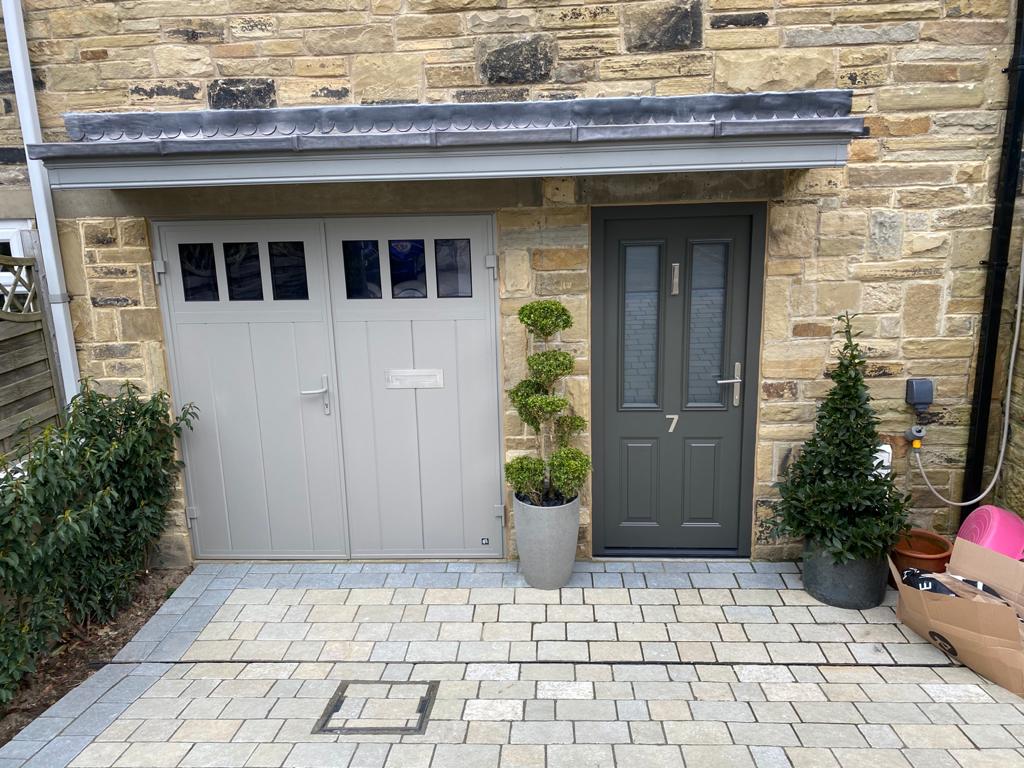
Side-hinged Doors – these garage doors open outwards, with a hinge positioned at the side. They are made of two panels, and swing outwards from the centre.
Sliding Doors – these garage doors open by sliding horizontally. Typically, the panels move sideways, along tracks that take them along the walls of the garage.
Up-and-over Doors – these garage doors open outwards and then upwards. They consist of one panel and, when fully open, sit completely horizontally, in parallel with the garage’s ceiling.
Wind-loaded Doors – garage doors that are precisely designed to withstand strong winds.
Automated Doors – garage doors where their opening and closing are automated, using an electronic motor system.
Garage Door Materials
Aluminium Doors – garage doors with panels that are made from aluminium. These make the doors lightweight and durable.
Wood Composite Doors – garage doors that are made from a composite mixture of materials. These combine wood fibres with other materials, to create a stylish wood appearance, which boasts increased high-performance benefits.
Vinyl Doors – garage doors that are made from vinyl. These doors are renowned for their low maintenance requirements, and high weather resistance.
Insulated Doors – garage doors with additional insulation.
Frosted Glass Doors – garage doors with added frosted glass panels, to bring extra natural light into the garage.
Technical Terms for Garage Door Components & Materials
Back hangs – horizontal supports, which fix the garage door’s track to the ceiling.
Cable drum – the door’s lifting cables are attached to the cable drum so that, when the door is used, they neatly wind and unwind around the drum.
Canopy – the name given to the state of an up and over garage door when it is completely opened.
Curtain – in roller garage doors, the curtain is the series of slats that form the front of the door (in some cases, the curtain of a roller garage door can also be a single piece of metal).
Cycle – a term for the operation of a garage door. One garage door cycle encompasses it going from closed to fully open, then fully closing again.
Fascia – a decorative board (typically made from either timber, UPVC or metal) that covers the area above the door’s frame, allowing the garage door to seal shut.
Guide rail – the channels that run along either side of a roller garage door, which guide the movement of the curtain.
Header bracket – a bracket that fixes the horizontal track to the wall, and is positioned above the door’s opening.
Jambs – vertical components of the frame, which sit on either side of the garage door opening. They are the points where the door hinges are attached.
Leaf – the name given to hinged door panels.
Lift handle – a handle that allows the garage door to be lifted manually (in the event of a malfunction).
Rollers – wheels on the door’s sides, which move along the horizontal tracks as the garage door opens and closes.
Safety edge – a key safety feature in automated roller doors, the safety edge detects any obstacles that are in the path of the door. If detected, it stops the door from closing.
Strut – a horizontal bar on the inside of the door, which is designed to provide additional support.
Sub frame – a frame that surrounds up and over side hinged doors.
Torsion spring – positioned above the door, this tightly wound spring counterbalances the garage door’s weight.
Track – the guides in roller garage doors and sectional garage doors. When these doors open and close, their roller wheels follow these tracks, to ensure a smooth, easy motion.
The horizontal tracks are the garage door tracks that are positioned along either side of the garage door, which the door follows as it opens and closes.
Track radius – unique to each garage door model, this denotes the curvature of the door’s horizontal track.
Weather stripping – a rubber strip that is fitted along the door’s entire perimeter, to improve its weather resistance.
Winding sleeves – components in a garage door’s spring system. They withstand the force of the torsion spring, ensuring it can be wound and unwound safely.
With this glossary to hand, you should have a much more comprehensive knowledge of garage door types, and how they work.
At Wolf Doors, our team of garage door specialists are highly trained, fully qualified, and have extensive experience working with a huge range of garage door types.
So, if you have any further questions about garage door installations, repairs or maintenance, don’t hesitate to contact our team.


